 Skip to content

Serengeti National Park
The endless plains of Tanzania
“Siringet” – the largest mammal migration on earth, 3,000 lions and 14,763 km² of endless savannah
The most important facts in brief
Topic | Details |
Name (Maasai) | “Siringet” – the place where the land goes on forever |
Location | 325 km west of Arusha; 7-8 hrs drive or 45-60 mins charter flight (Seronera, Grumeti, Kogatende) |
Area | 14,763 km²; more than 40x larger than Lake Manyara; Part of an ecosystem of >30,000 km² |
Border | North: Kenya’s Masai Mara (no fence); East: Ngorongoro NCA; West: Grumeti/Ikorongo Reserves |
Great Migration | 1.5 million wildebeest + 250,000 zebras + hundreds of thousands of gazelles; 800 km cycle, unchanged for >1 million years |
Lions | Approx. 3,000 lions in the ecosystem – largest population in Africa; highest density in the Seronera region |
Cheetahs | Highest density of cheetahs in Africa; Simba Kopjes and Ndutu Plain best locations |
Bird species | >500 species; Most species-rich bird area in northern Tanzania |
Calving time | Jan.–March, Ndutu Plains; up to 8,000 calves/day in February |
Mara Crossing | July–October in the north; not datable – herds can wait for days, then cross several times a day |
Balloon Safari | Approx. 599 USD/person; 1 hour flight + bush breakfast; Start 6:00 a.m.; Advance booking mandatory |
Accommodation | Budget from about $350/night; Mid-range $500–800; Luxury 900–2,500+ USD/person/night |
Geographical location and structure
“Siringet” – that’s what the Maasai called it: the place where the land goes on forever. The Serengeti National Park is located 325 kilometers west of Arusha in northern Tanzania. By road, it takes 7 to 8 hours, depending on the route and intermediate stops; by charter flight from Arusha or Kilimanjaro International Airport less than an hour to the Serengeti airstrips in Seronera (Central), Grumeti (Western Corridor) or Kogatende (North).
At 14,763 square kilometres, the park is more than 40 times larger than Lake Manyara – and as part of the larger Serengeti ecosystem with Masai Mara, Grumeti and Ikorongo Game Reserves, the contiguous wildlife area covers over 30,000 square kilometres. In the north, the park borders Kenya’s Masai Mara National Reserve without a fence: no boundary stone, no obstacle separates the two protected areas – only grass and sky.
The landscape is endless, but not monotonous. Four clearly different regions with their own character, their own wildlife and their own optimal travel time make a Serengeti trip a planning topic that goes beyond the simple question “When is the migration?”.
The four regions – and why the election is crucial
Region | Best time | Highlight | Recommended accommodation |
South Serengeti / Ndutu | Dec.–March | calving period; high predator concentration; Calves and lions | Kusini Camp, Mwiba Lodge, Olakira Camp |
Central (Seronera) | All year round | Seronera River; Leopards, lions, cheetahs | Four Seasons Serengeti, Lemala Ewanjan, Nimali Serengeti |
Western Corridor | May–July | Grumeti river crossings of the wildebeest herds; Crocodiles; fewer visitors | Mbalageti Lodge, Singita Grumeti, Sabora Tented Camp |
North Serengeti / Mara | July–Oct. | Mara River Crossings; most dramatic migration scenes | Sayari Camp, Lemala Kuria Hills, Nomad Lamai |
Lobo (northeast) | All year round | Rocky landscape; few visitors; exclusivity; Leopards | Lobo Wildlife Lodge, Taasa Lodge |
* Mobile camps follow the herds and rotate seasonally between Ndutu and Mara – ideal for travelers who want to follow the migration
What makes the Serengeti unique
- The Great Migration – a unique natural phenomenon: Over 1.5 million wildebeests, 250,000 zebras and hundreds of thousands of gazelles follow an 800-kilometre clockwise cycle. This migration has remained unchanged for over a million years and does not take place in its entirety anywhere else on earth.
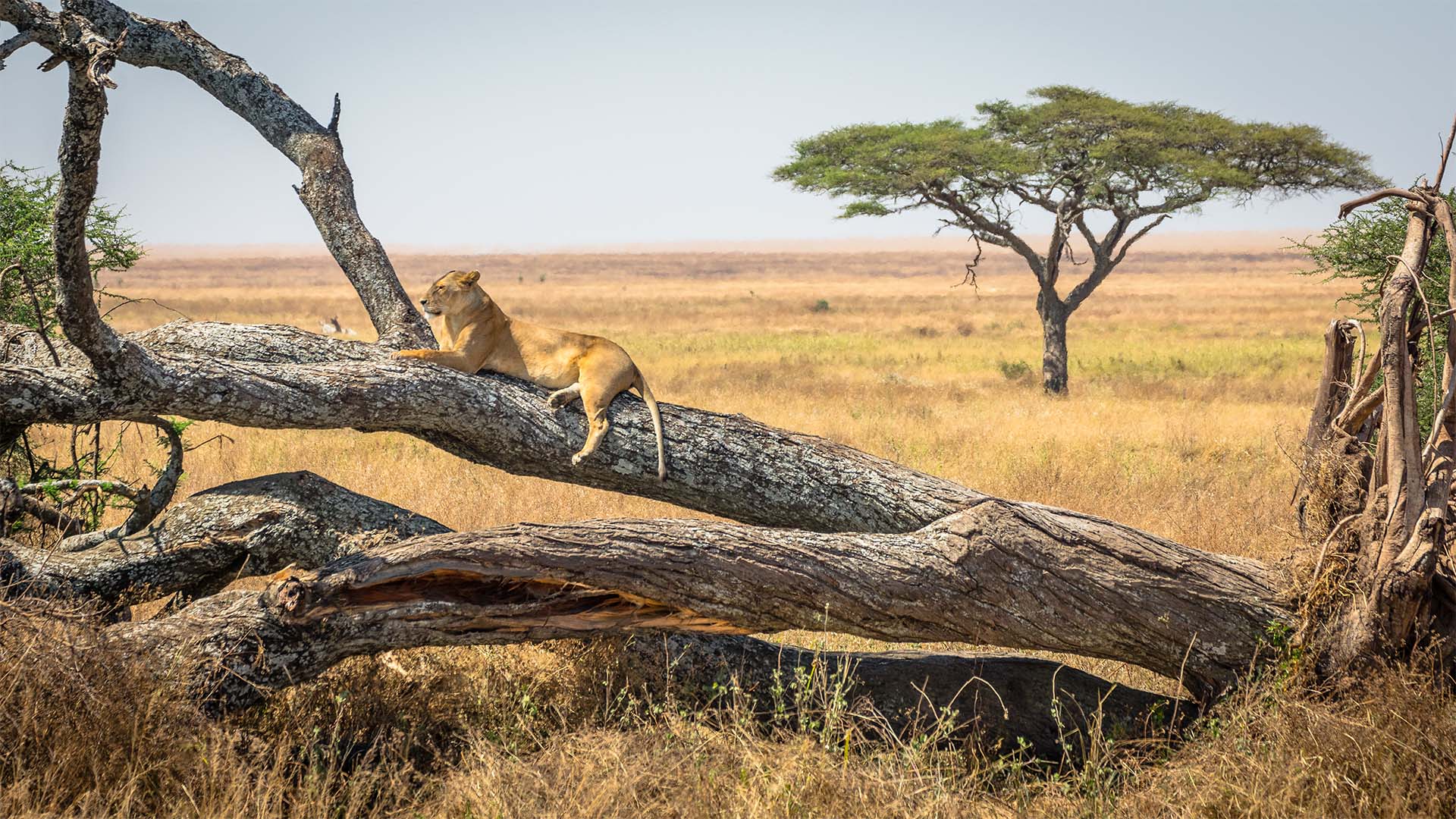
- Largest lion population in Africa: The Serengeti ecosystem is home to an estimated 3,000 lions – the densest known population on the continent. In the Seronera region, lion sightings are almost guaranteed all year round.
- Highest density of cheetahs in Africa: The open short-grass plains are ideal hunting grounds. Most reliable sites: Simba Kopjes southeast of Seronera (dry season) and Ndutu plains (calving season Jan.–March). Early in the morning, 6–9 a.m., best chances.
- Over 500 bird species: The most biodiverse bird area in northern Tanzania; surpasses Lake Manyara in absolute number of species. Especially from November to March, with migratory birds from Europe.
- Real boundlessness: No fence, no fencing. Animals roam freely between Tanzania and Kenya. The feeling of infinite space – “Siringet” – is the essence of this park.
- Four regions, one park: Central Serengeti, Western Corridor, North Serengeti and Lobo offer such different landscapes and experiences that a week’s stay is hardly enough to capture them all.

The Great Migration – Annual Cycle and Planning
The migration is not a fixed date event. It is an annual cycle – driven by rain, grass and the instinct of survival. If you want to “see migration”, you first have to decide: Which part of the cycle?
Month | Position of the herds | Highlight | |
Jan.–March | South Serengeti, Ndutu Plains | calving period; up to 8,000 calves/day in Feb.; intense predator activity | |
April–May | Central Serengeti, heading west | rainy season; herds migrate; fewer tourists; Lush vegetation | |
June–July | Western Corridor, Grumeti River | Grumeti River Crossings; Crocodiles; Transition to the north | |
July–Oct. | North Serengeti, Mara River | Mara River Crossings; the most dramatic scenes of migration; Return migration to the south | |
Nov.–Dec. | Retreat to the South | Green savannah; Migratory birds; few tourists; lower prices |
Calving season Ndutu (January to March) – the underrated highlight
From January to March, the wildebeest gather on the grassy plains on the southeastern edge of the Serengeti near Lake Ndutu. At its peak in February, up to 8,000 calves are born every day – an offer of prey that lions, cheetahs, hyenas, jackals and vultures are already waiting for. The interactions between newborn calves and predators are among the most intense wildlife experiences the Serengeti offers – and are often preferred by connoisseurs to the Mara Crossing season because the number of visitors is significantly lower.
Mara River Crossings (July to October) – the most dramatic scene of migration
The river crossings on the Mara River in the north are the most iconic image of migration. Tens of thousands of wildebeest jam on the shore – sometimes for hours. Then the mood breaks: an animal takes its first step into the crocodile-infested water, and within minutes a dark avalanche plunges through the river.
Important caveat: Crossings cannot be set to a date. Herds can remain on the shore for days and then cross four or five times in a single day. If you travel exclusively for the crossings, you should plan at least 3-4 days in the Mara region.
Grumeti Crossings (June/July): Less well known, but often more accessible. In the Western Corridor, the herds cross the Grumeti River – with giant Nile crocodiles waiting to be crossed. Significantly fewer vehicles than at the Mara.

Seronera – The year-round reliable centre
Seronera, in the center of the park, is the most visited region – and for good reason. The permanent river system of the Seronera reliably attracts animals even in the dry season, when water points dry up elsewhere. Leopards in fig trees, lions on the granite kopjes, elephants on the shore, and a high density of cheetahs on the open plains make Seronera the most reliable game drive area in the entire Serengeti – all year round.
Most reliable cheetah spots: Simba Kopjes, southeast of Seronera – especially in the dry season. Cheetahs use the elevated granite rocks as a lookout and sunbathing area. Early in the morning 6-9 a.m. best activity window.
Kopjes – Small ecosystems, big drama
The granite rock formations that rise abruptly from the flat savannah are one of the most distinctive features of the Serengeti. Rock hyraxes, monitor lizards, cobras and especially lions live on and in the kopjes, which use the elevated position for a view and cooling. The Simba Kopjes southeast of Seronera are among the most reliable leopard and lion spots in the entire park – can be combined with the nearby Seronera river system as a day route.
Balloon Safari – The Serengeti from above
A sunrise balloon safari is the only experience in the Serengeti that no jeep can replace: lions hunting from above, herds of wildebeest as dark currents in the grass, silence – just the sound of the burner.
- Cost: $599/person (standard package, shared); Charter balloon on request approx. 3,000–5,000 USD. Price includes transfer to the starting base, 1 hour flight, champagne bush breakfast, field certificate.
- Itinerary: Pick-up from the lodge approx. 4:00–5:15 a.m. (depending on the distance to the starting base); Take-off approx. 6:00 a.m. – 6:15 a.m.; Landing after approx. 60 minutes, followed by a bush breakfast and a short game drive back to the lodge.
- Starting base by region: Seronera: all year round. Ndutu: December to March. Western Corridor: May to September. North Serengeti: July to October.
- Booking: Ideally in advance, especially July to October fully booked. Children under 7 years of age are not admitted.

Travel times: Month by month, region by region
Period | Conditions | Recommendation & Region |
Jan. – March | Calving season Ndutu (up to 8,000 calves/day in Feb.); most intense predator activity of the year; short dry period Jan./Feb. with good visibility; fewer tourists than in high season | South Serengeti / Ndutu; best time for predator interactions |
April – May | rainy season; herds are moving westwards; Slopes sometimes difficult; individual camps closed; lush vegetation; very few tourists; Cheapest prices | For the determined, Western Corridor is starting to get interesting |
June – July | Dry season begins; Grumeti River Crossings (June/July) in the Western Corridor; herds are moving north; Pleasant temperatures 18–26°C | Western Corridor; Grumeti crossings; less crowded than Aug/Sept |
Aug. – Oct. | High season; Mara River Crossings to the north; low vegetation; best visibility conditions; highest visitor numbers and lodge prices; Temperatures pleasant | North Serengeti; Mara River; Balloon Safari; Booking well in advance |
Nov. – Dec. | Short rainy season; Herds are moving south; Savannah green; Migratory birds from Europe; significantly fewer vehicles; Prices are falling | Insider tip; Photographers; Birdwatchers; Central + South |
Principle: The Serengeti is great all year round, because the ecosystem is at its peak at any time in any region. The question is not “When is there something to see?”, but “What do I want to see and in which region?”
Travel and logistics
- By road: 325 km from Arusha, a 7-8 hour drive via Ngorongoro or via Lake Manyara. Doable, but long – usually combined with stops in Lake Manyara and Ngorongoro.
- By charter flight: strongly recommended for travelers with limited time. From Arusha or KIA, about 45-60 minutes to the Serengeti airstrips Seronera, Grumeti, or Kogatende (North). Several daily connections with Coastal Aviation, Air Excel, and others.
- Minimum stay: 3 nights for one region; 5-7 nights for two regions (e.g. Seronera + Ndutu or Seronera + Mara).
- Mobile Camps: Follow the herds seasonally; change locations 1–2 times a year. Ideal for travelers who want to follow the migration without changing lodges. Booking well in advance.
- Combination Ngorongoro: On the main route via Karatu; 1 day Ngorongoro makes sense as a stopover – or as a separate 2-night stay.
Conclusion
The Serengeti is not a park that can be understood in a single visit. It is an annually changing ecosystem that shows a new face with every season and in every region. The decisive planning principle: region and period must fit together. If you go to the South Serengeti in July, you will miss the Mara Crossings. If you travel to Ndutu in October, you will miss the calving season.
The Serengeti rewards planning with experiences that cannot be repeated: 8,000 calves on a single February day in Ndutu. A cheetah mother with three cubs on a Simba kopje in the morning light. And the moment when a herd of ten thousand wildebeest decides to cross the Mara – and nothing in the world can stop them.

Discover Tanzania's
True Wilderness with
TANGER SAFARIS
Experience Tanzania’s magic with Tanger Safaris. We create unique journeys, rich wildlife encounters, and authentic cultural experiences. Let our expert team plan your perfect safari adventure across breathtaking destinations.